Cancer Awareness and Resources
Associated Fire Fighters of Illinois
The National Firefighter Registry (NFR) for Cancer is the largest effort ever undertaken to understand and reduce risk of cancer among U.S. firefighters.
NIOSH is recruiting firefighters to join the NFR so that we can better understand the link between firefighting and cancer.
Firefighters are exposed to chemicals on the fireground that could increase their risk of developing cancer. There are many unanswered questions about how cancer risk may vary across our nation’s diverse fire service.
Having many types of firefighters join the NFR is vital to examining the relationship between firefighting and cancer. This includes minority, female, and volunteer firefighters, as well as groups like wildland firefighters. The more researchers know about cancer, the more that can be done to prevent it.
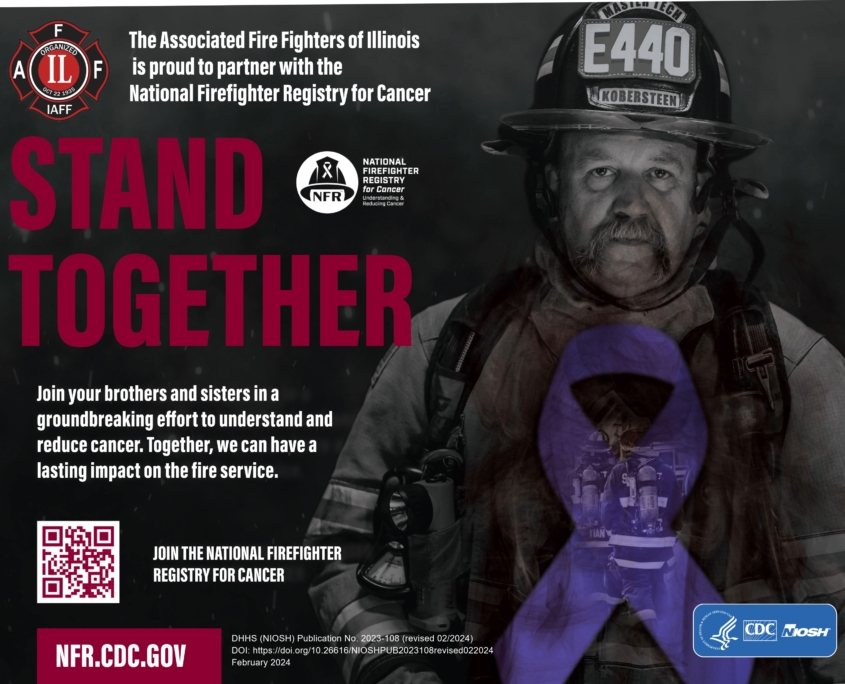
In 2018, Congress passed the Firefighter Cancer Registry Act. This Act directed the National Institute for Occupational Safety and Health (NIOSH) to develop a voluntary registry to better understand the link between firefighting and cancer. The NFR is the largest effort undertaken so far to understand and reduce cancer among U.S. firefighters.
Studies show that firefighters may have a greater risk of some types of cancer due to their exposure to smoke and hazardous chemicals on the fireground. Many of these studies did not include volunteer firefighters or enough female or non-white firefighters to draw conclusions about their specific cancer risk. The NFR was created to address these knowledge gaps. The NFR will collect information from a large and diverse population of firefighters, with representation from previously understudied groups. Therefore, it will be possible to study cancer risk among different groups of firefighters.
All U.S. firefighters, with or without cancer, no matter their length of service. This includes:
Participation is voluntary.
Having many types of firefighters join the NFR is vital to examining the relationship between firefighting and cancer. The more researchers know about cancer, the more that can be done to prevent it.
By joining the NFR, you can:
Yes. All firefighters, with or without cancer, are encouraged to join the NFR, and their participation is critical for understanding firefighters’ risk of cancer.
It is important that both firefighters with and without cancer diagnoses join the NFR. Having both will allow NIOSH scientists to compare those who develop cancer over time to those who do not. This will help us better understand what factors contribute to cancer development in firefighters.
Currently, in the United States, cancer is a reportable illness in all 50 states. However, most states do not collect detailed information about occupation. So, if a firefighter develops cancer in the future, scientists may not know they are a firefighter unless they are enrolled in the NFR. The NFR is way for people to identify themselves as a firefighter and provide details about their work history and other factors. This makes it possible to study the relationship between firefighting and cancer over time. Combining information from firefighters across the U.S. will help researchers better understand cancer and its risk factors in the fire service, which could ultimately help reduce cancer among firefighters for generations to come.
Every time someone is diagnosed with cancer, their healthcare provider submits information about the diagnosis to state cancer registries for public health purposes. However, little information about cancer patients’ work history is collected in these state cancer registries. So, a firefighter’s cancer diagnosis would be captured by the state cancer registry where they live, but not detailed information about their occupation (or time as a volunteer firefighter).
The NFR will help researchers address this knowledge gap. When you sign up for the NFR, you will be asked to provide your name and other identifying information (e.g., date of birth). This will allow NIOSH researchers to match the information you provided in the NFR to cancer diagnosis information from state cancer registries. This makes it possible to study the relationship between firefighting and cancer outcomes over time. Watch this video to learn more about how the NFR works.
Visit NFR.CDC.GOV to join. Full registration will take about 30 minutes, but it does not need to be completed all at once. You can log out at any time and pick up where you left off. The initial steps of creating an account, signing a consent form, and completing a user profile can be completed in 5-10 minutes.
When joining the NFR, you will provide some information about yourself – name, date of birth, and some basic information about work exposures and lifestyle. You can find more information about how to sign up in this fact sheet.
We understand not all firefighters use the same terminology. We suggest answering questions to the best of your ability, or you can select “N/A”. For example:
Privacy and data security are top priorities for the NFR. Firefighters join the NFR through a secure website using multi-factor authentication and firefighter data is stored securely with multiple layers of encryption. Your information will be kept confidential and only accessible to NIOSH researchers. Watch this video to learn more about how NIOSH will protect firefighters’ data.

Offers comprehensive cancer screening services tailored to the needs of firefighters, including testing for various types of cancers.
Provides research and educational resources on cancer risks associated with firefighting, along with information on preventive measures and screening programs.
Focuses on innovative cancer detection methods and provides resources specifically for those in the fire service.

Specializes in cancer detection and screening technology, offering tools and tests that can aid in the early detection of various cancers.